The Library of Obscure Wonders

art nature illustration botanical classes workshops

Category: Uncategorized

Garlic

Garlic cloves

Garlic cloves allowed to grow. Limited edition print by Jo Fisher Roberts

Garlic, Allium ursinum, has been used by people for over 7000 years. It grows in Asia, Africa and Europe. It’s planet is Mars and its element fire, it’s deity is Hecarte. Garlic was eaten at festivals to Hercarte, and left at crossroads to her name. Often planted in the garden or worn around the neck to protect against evil spirits garlic has also been used to help  boost the immune system, protect against hepatitis, to guard against foul weather and as an antiseptic. It was used in Ancient Egypt to give the builders of the pyramids energy and strength.

Moon Poo, Wolf Milk, Tree Hair And other types of Slime

slime moulds

An illustration of slime moulds

“There is only one rule to life” said my biology teacher on one of his more whimsical days “for every rule you find you can always find something that breaks it”.

Ignoring the obvious contradiction he preceded to educate us in a creature that was not animal or plant, not multi-cellular or single cellular, but very possibly alien.

In 1973 in Dallas, Texas, firefighters were called out because a strange yellow blob was attacking a telephone pole. The firefighters tried to subdue it with hoses, but the creature grew bigger and climbed up the pole. Locals feared an alien invasion. Yellow blobs had recently been appearing on their lawns and now this giant blob was seemingly eating the telephone pole. Luckily, a local university scientist identified the oozing slime as F. septica. a harmless slime mould.

It is unusual for slime moulds to be this large, they are usually tiny, very slimy and not a mould. Having been banished from the fungi class in recent history for having very little relation to a fungi, they now have their very own kingdom, yet still perplex scientists as to where exactly they fit in. They come in many different colours – yellow, pink, white, green, brown, black – and have many different common names such as Tree Hair, Bubble Gum, Chocolate tubes, Wolf Milk , Dog Vomit and Caca de Luna (Moon Poo) which I’m informed is delicious when fried.

There are two main types of Slime Mold, the Plasmordial – basically one great big cell with many nuclei – and the Cellular – these spend most of their life as single celled amoeba but when food gets short a chemical signal is released and they come together to form “slugs”, with head part, body and tale, that go wondering off to find somewhere better.

At some point they then turn into fruiting bodies, with some of them being sacrificed in order to do this. Their life cycle intrigues scientists for the questions it raises about altruism.

A fairly recent Slime Mould discovery is that although they don’t have a brain, or anything even approaching, they do use a type of external memory. Hansel and Gretal style. Build a small maze in a petri dish, on one side of the maze put your Slime Mould, on the other put a delicious food supply. The Slime mould will work its way round the maze leaving behind a slime trail so it knows where it has been before and doesn’t return there.

Life Cycle of Slime Mold

Life-cycle of a Slime Mould

Whats more these things are all around, everyday, lurking in the corners of your life, in the garden, in the town, maybe in your house. So with their ability to exist as both single and multi-celluar organisms, their altruism,  being able to find their way through mazes, and most of all their ability to still completely baffle humans, slime moulds are fantastic!  (And are the future)

The Snake Amongst Rubbish.

Art work - Snake painting

Watercolour and Gouache on handmade paper, with bed springs and litter.

This beast has just successfully got to America, much to my relief. I could see the authorities objecting to rusting bed springs in a package arriving from across the continent, but it got there safely. It is one of my earliest experiments in embedding and painting on handmade paper. It is an incredibly lengthy process with a high possibility of it going wrong at any stage – the paper-making, the drying, the embedding, and when it comes to the image, well you can’t rub out on handmade paper! The error possibilities are enormous, quite crazy in fact, but it is very rewarding once finished. There is also the curious thing that because it’s created from recycled materials the materials and the making process play a role in how the final image turns out, almost tell their story by influencing my decisions as I make it.

I found the bed springs in my garden, when I was trying to build a pond. An entire mattress is buried under the ground, rotten away so that it is just a huge bunch of strings and wire. I thought I saw a snake slithering amongst the strings, but it was probably my eyes playing tricks on me again.

The snake is a fascinating animal. The word snake comes from the term “to creep”. The forked tongue smells as well as tastes, and is constantly in motion sampling particles from the air. Many snakes also have infrared-sensitive receptors to detect the heat given off by warm blooded creatures. Most impressive, from a visual point of view, is their  jointed skull and highly mobile jaw which enables them to eat prey far larger then their heads, and often live.

Dr. BoBo Chaplin’s Cabinet of Curiosities

481px-PhrenologyPixThese photographs are of the notable Cabinet of Curiosities belonging to charismatic phrenologist “Dr. BoBo” Chaplin (1792-1864?) born in Zion House, Twickenham, London.

Phrenology is a process that involved observing and feeling the skull to determine an individual’s psychological attributes. Dr. BoBo believed that the brain was made up of 27 individual organs that determined personality. He would run his fingertips and palms over the skulls of his patients to feel for enlargements or indentations. He would often take measurements with a tape measure of the overall head size and more rarely employ a craniometer, as displayed in the cabinet.
The contents of the cabinet were dispersed in 1968 after disagreements over its rightful ownership (Chaplin vs. Adams, June 1967). It is thought that many of the pieces were lost during this period. The relatively small collection of exhibits which remained in England are currently on display as part of the Library of Obscure Wonders at The Hundred Years Gallery until the 2nd March 2014.

Inside Dr.BoBo's cabinet

Inside Dr.BoBo’s cabinet

A photo of the insides of Dr BoBo's cabinet.

A photo of the insides of Dr BoBo’s cabinet.

At the Hundred Years Gallery

ImageThe Library will be having an exhibition at the end of February. This time at the Hundred Years Gallery in Shoreditch. The exhibition will show the Libraries Cabinets of Curiosity, donated by various artists, scientists and explorers. It will also show the work of Giles Leaman and Jo Fisher Roberts, two artists that make their work from recycled materials, a soundscape by Cos Chapman and three nights of performance. Here are the details:

‘The Library Of Obscure Wonders’: Jo Roberts & Giles Leaman. 19th of February to 2nd of March

Private view involving a Sin Eating Ritual on the 20th of February

Jo Fisher Roberts is an artist and illustrator. Interested in the natural world, she combines traditional illustrative techniques with experimentation and found materials; the carnivalesque and the surreal.

The Woods: “When I was about the age of 10 I was with my family on a walk in woods in west Wales. As usual on such walks I had fallen behind the group. Dawdling along daydreaming I suddenly froze. Just couldn’t move.

Everything became super-real, bright and overwhelming, the noises were intense. Tiny details such as fungus, mud, leaves seemed god-like, immense and all powerful. There was no time. There was no separation between myself and the trees, the plants, the mud, and the water around me. They knew me, were me and I was them. I tried to hang on to normal reality, but that seemed distant, a thin theatre played on top. Even the thought “I” didn’t make sense any more. The experience was beautiful, incredible, ecstatic and horrific all at the same time. Terrifying.

“After what must have been just a few minutes I came round, heard my family calling for me and ran to catch up with them.

“Episodes similar to this were repeated and sometime later I was diagnosed with a type of epilepsy, but this experience, no matter what its causes, has always been important to me and my artwork can’t help but explore that “other” interconnected world. My work uses recycled materials. There is so much manufactured stuff in the world it can feel good to find the beauty in that which is used and thrown out: the constant dying and renewing process reminds me of the woods and the cycle of life.” JFR

The soundtrack is a collaboration between Jo Fisher Roberts and Cos Chapman. Constructed from extended vocal improvisations and processed using electroacoustic techniques to cerate a soundscape out of clearly human utterance.

The exhibition on the 1st March will also host the first phase of Spletza Martin Adventures. Storytelling, ritual performance, film and contemporary cabaret meet to create an exciting new cross-artform collaborative enterprise.

“Painting with paper, drawing with sound. Collages, sound sculptures and other explorations”.

Giles Leaman is a London based artist, musician and arts practitioner whose work traverses sound, installation, performance, sculpture and 2D artforms. His interest in found objects and the challenge set by using them, informs the process in which he works, ”It is as if the material creates a spark to a hitherto unexpected wave of energy, which then in turn consumes everything”. This spark or connection can sometimes be between two materials or a technique and a material or an idea looking for a framework in order to exsist.

The work ranges from collage, using found fragments, printing, drawing and painting, sculpture and assemblages to sound sculptures and experiments with diverse materials.

As a maker, and art enabler for art workshops for 25 years, a vast range of techniques and materials have been tested, manipulated explored and played with, and it is this playful air has lead to a demystifica\tion of “Art” or creativity being out of touch for most people, and more of an energy that can be encouraged and tapped into.

This show is an opportunity to combine new experiments with exsisting works, to break down barriers and put them up again.

Giles Leaman has worked as a printer, Designer of sound environments, a musician with various groups and with Puppeteers, dancers, artists Carnival Arts and as an art enabler for young people.

Events during the exhibition include:
February 23rd – Masks and drums Workshop with performances by The Librarian, KMAT, Cos Chapman, Giles Leaman
March 1st – Chutney Preserves present Mad March Tea Party late afternoon
March 1st -EP launch of Rude Mechanicals in the evening
Closing workshops and performances on the 2nd March


Blithe Nook – Bethnal Green

Litter mosaic

A mosaic of a leaf created from street litter in Bethnal Green park.

Bethnal Green is a district in East London, England.

This was a site specific installation about the origins of Bethnal Green in the Belfry at St Johns in London on 5 September until 3 October 2013

“the earliest form of Bethnal Green is derived from the Anglo-Saxon healh (‘angle, nook, or corner’) and blithe (‘happy, blithe’).
A settlement’s dependence upon water suggests that the ‘happy corner’ was cleared next to the natural spring… Over time, the name became Bethan Hall Green, which, because of local pronunciation as Beth’n ‘all Green, had by the 19th century changed to Bethnal Green.” Wikipedia

Blithe Nook takes its starting point from this description on the origins of Bethnal Green. Imagining the area as a clearing next to a spring, and how special it must have been to the local residents, it tries to capture the ghost of this and connect it to the busy metropolitan area it has now become. The piece includes botanical mosaics made from recycled street litter, cabinets showing aspects of the area that have caught the curiosity of residents and passers by, a soundscape comprising of sounds from the Green and an opportunity for visitors to contribute their own items of curiosity or wonder. There will also be live art performances on the opening night. St John on Bethnal Green 200 Cambridge Heath Road, E2 9PA London, United Kingdom

Lead Artist : Miss Roberts. Participating artists and performers: Cos Chapman, Emma Harvey, Tracey Holloway, Jude Cowan Montague, Jill Rock, Calum F. Kerr, Mick Frangou, Ed Boucher, Lee McFadden, Tracey Holloway, Phillip Raymond Goodman, Punkvert, Gardyloo Spew, Django Bates, Bitten By A Monkey, Matt Scott, Jowe Head and DemiMonde

http://www.obscurewonders.co.uk/blithe.html

Natural History Illustration Course

ImageSundays throughout July at City Lit, London. http://www.citylit.ac.uk/courses/Art_and_design/Illustration/Natural_history_illustration/VK440

Learn how to capture wildlife on paper, from fossils to fleeting birds and butterflies. Gain skills using a variety of different media including digital. The course will include trips to the Natural History Museum.

The Devil’s Toenail

Fossil Oyster

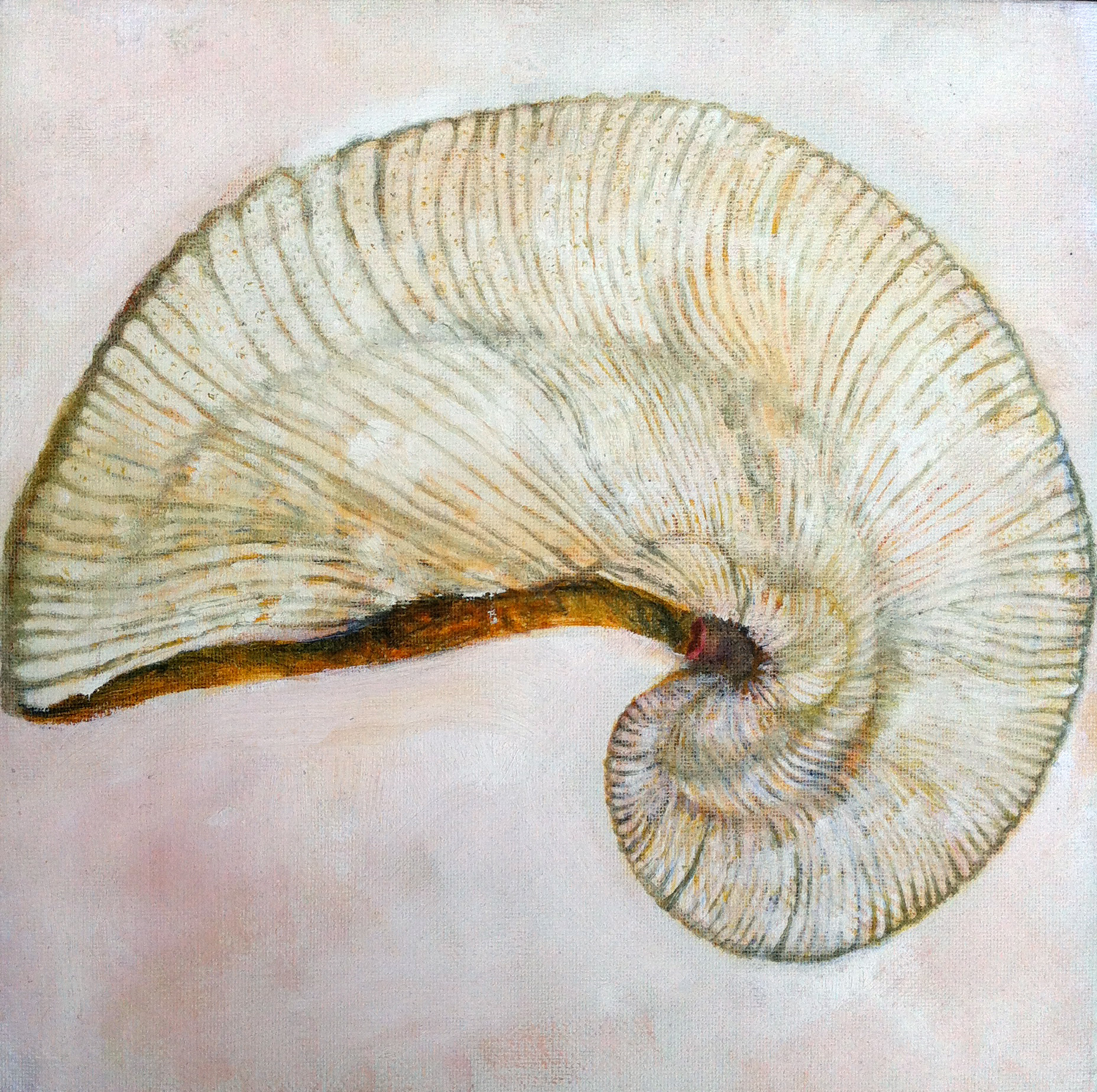
Gryphaea – Devil’s Toenail – Oil on Canvas. If you happen to know someone who might like a pretty picture of a shell on the bedroom/lounge wall you can buy it here – https://www.etsy.com/listing/115644293/painting-of-a-shell-fossil-devils-toe, probably best not mention the devil’s toes though.

This is the fossilised shell of a now extinct oyster from the Jurassic period. Found on the coastlines of Britain, they are called Devil’s Toenails because they look like they might possibly be just that!

It used to be believed that taking crunched up Devil’s Toenail as medicine could relieve a bad back and help cure rheumatism.

My favourite example of the devil is given in The Karamazov Brothers by Dostoevsky. He appears to one of the brothers in a hallucination. He is a gracious, dignified gentleman, educated but fallen on hard times, his clothes are tatty and run down. He  says what he dreams of being is the fat 18 stone wife of a merchant  “and to believe everything she believes”. Then he wouldn’t have to worry, no responsibilities or guilt, just live in luxuary and believe oneself to be a good christian “my ideal is to walk into a church and light a candle in all sincerity”. I can see the devil having that point of view, and in his well made but hole ridden shoes he would have curled deformed toenails that look very much like this.

Bird Radio

A modern one man band.

He’s a very busy man. We are only just getting him to perform with us on Wednesday before he and Chiara Ambrosio fly off to New York together to do a tour of the States the next day.

His music is both medieval and contemporary, etherial and earthy. I envy the way he manages to coordinate so many things live on stage in a song, playing a red suitcase as a drum, operating a loop pedal, playing flute, singing. Some looped music can become quite hypnotic, but Bird Radio manages to be very much there, and engaged with the audience.

His persona is friendly and draws the audience into his world where nursery rhyme and original material mix in surprising ways.

In this video (by Chiara) of the song Who Killed Cock Robin he looks quite fierce and aggressive, but really his stage persona is very loveable.